On February 19, 1923, the United States Supreme Court issued a unanimous ruling in United States v. Bhagat Singh Thind that declared South Asians ineligible for U.S. citizenship. Nine unelected judges, in a single decision, stripped the legal standing of an entire people from the fabric of American law — and their ruling set off a cascade of consequences that ruined businesses, seized property, and drove at least one man to his death.
Today is the 103rd anniversary of that decision. It deserves to be remembered — not just as a historical injustice, but as a precise illustration of why unchecked judicial power is dangerous, why the Court’s institutional consensus is no guarantee of moral correctness, and why structural reform is not optional.
Who Was Bhagat Singh Thind?
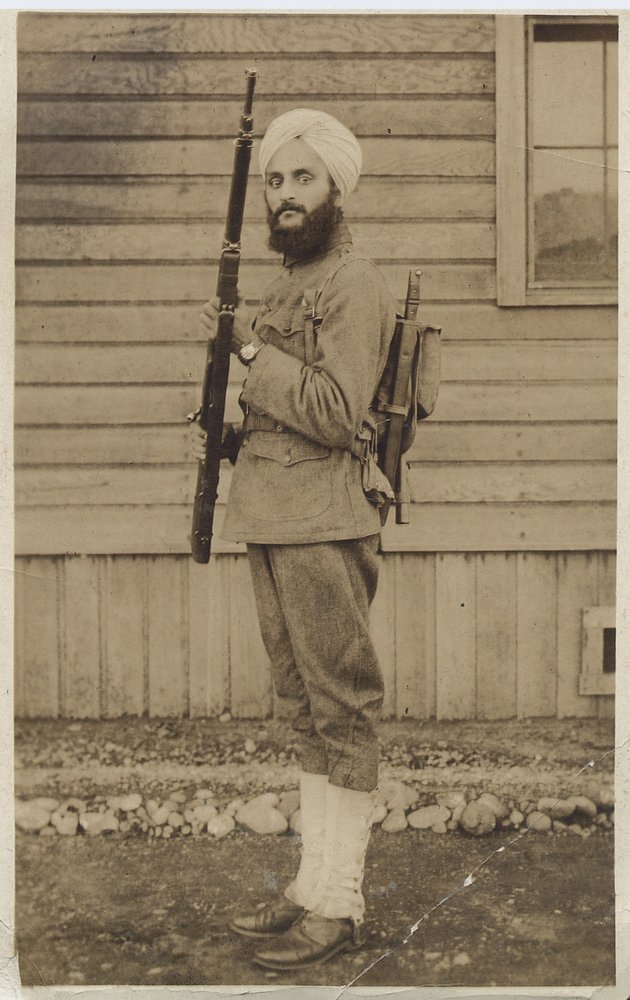
Bhagat Singh Thind in his U.S. Army uniform, 1918. He served at Camp Lewis, Washington, and was honorably discharged as a Sergeant. (Public domain, via Wikimedia Commons)
Bhagat Singh Thind arrived in the United States in 1913 from Punjab, India, seeking higher education. He was not a passive observer of American civic life. He enlisted in the U.S. Army during World War I, served honorably, and was discharged as a Sergeant with an “excellent” character rating. He had fought for this country.
After the war, Thind applied for citizenship — as he was entitled to do under the Naturalization Act of 1790, which limited naturalization to “free white persons.” Thind argued, drawing on the racial science of his era, that Indians were classified as “Caucasian,” and therefore qualified as white under the statute.
In 1918, a court in Washington state agreed and granted him citizenship. The Bureau of Naturalization moved to cancel it within four days. In 1920, an Oregon federal court granted him citizenship again. The government challenged it again, and the case made its way to the Supreme Court.
The Court’s Reasoning: “Common Understanding” as Cover for Racism
Justice George Sutherland, writing for a unanimous nine-justice Court, acknowledged that Thind’s argument had scientific merit — South Asians were indeed classified as Caucasian under the anthropological standards of the day. But the Court rejected it anyway.
Sutherland’s reasoning was this: the word “white” in the 1790 Act should be understood not through scientific classification, but through its “common meaning” — what an ordinary person on the street in 1790 would have understood the word to mean. And in that “common understanding,” someone who looked like Bhagat Singh Thind was not white.
Let’s be precise about what the Court did here. When scientific classification supported Thind’s claim, the Court discarded science and appealed to popular prejudice. The “common understanding” of white Americans in 1923 — shaped by decades of nativist agitation, anti-Asian legislation, and explicit white supremacist ideology — became the legal standard for citizenship. The Court dressed up racial gatekeeping in the language of textual interpretation and called it law.
It was unanimous. All nine justices agreed.
The Cascade of Consequences
The Thind decision was not abstract. It had immediate, concrete, devastating effects on real people.
Between 1923 and 1927, approximately 50 Indian Americans who had already been naturalized had their citizenship retroactively stripped. People who had built lives, businesses, and families in America on the basis of their legal standing suddenly had that standing erased — not because they had done anything wrong, but because nine men in Washington decided their skin disqualified them.
The consequences compounded. California’s Alien Land Law, like those of several other states, prohibited “aliens ineligible for citizenship” from owning agricultural land or operating businesses. With the Thind ruling reclassifying South Asians as non-white and therefore ineligible for citizenship, denaturalized Indian Americans lost the legal right to own property. Farms, businesses, and assets built over years of work could no longer be held in their own names.
Vaishno Das Bagai: A Life Destroyed
No single story captures the human cost of Thind more clearly than that of Vaishno Das Bagai.
Bagai had immigrated to San Francisco in 1915 with his wife Kala and their children, bringing significant savings with him. He opened a store in San Francisco, became naturalized, and built a life. He had explicitly renounced his British citizenship — a significant act for an Indian nationalist who saw British colonial rule as illegitimate — because he intended to become fully American.
After Thind, the government moved to strip his citizenship. Under California’s Alien Land Law, he could no longer own property or run his business. He was effectively stateless: he had given up British citizenship and now American citizenship had been taken from him. When immigration authorities told him he could travel only on a British passport — the passport of the empire he had deliberately rejected — he refused.
On March 16, 1928, Vaishno Das Bagai died by suicide in a San Jose hotel room. He left behind a letter addressed to the San Francisco Examiner that read in part: “I came to America thinking, dreaming and hoping to make this land my home… I am no more British subject. It is not in my power to become a citizen of this country. I am not treated well in California… Is life worth living in a gilded cage? Obstacles this way, blockades that way, and bridges burnt behind.”
He was 36 years old. His wife Kala survived him and later remarried, eventually becoming a U.S. citizen under the Luce-Celler Act. She spent the rest of her life speaking about what had been done to her family.
The Supreme Court did not cause Bagai’s death with deliberate intent. But the Court’s decision created the legal architecture that made his life impossible. Unanimity and good legal form do not absolve an institution of the consequences of its rulings.
South Asians Locked Out Until 1946
The Thind ruling stood for more than two decades. South Asians could not naturalize as American citizens — regardless of their service, their ties to this country, or their commitment to its ideals — until the Luce-Celler Act of 1946, signed by President Truman on July 2, 1946.
And even then, the Act allowed just 100 Indians per year to naturalize. The rectification was grudging, quota-bound, and partial. Full equality for South Asian immigration would not come until the Immigration and Nationality Act of 1965 — 42 years after Thind was decided.
The Supreme Court did not reverse itself. Congress acted. The Court sat with its ruling intact until legislation forced a different outcome. The correction came not from judicial humility or a later Court recognizing the moral catastrophe of Thind, but from external political pressure, changing demographics, and international optics during the Cold War, when the United States found it embarrassing to maintain explicitly racial immigration bars while competing with the Soviet Union for influence in Asia and Africa.
What This Tells Us About the Court
The Supreme Court’s defenders often argue that however imperfect the institution may be, it ultimately gets things right — that the arc of its jurisprudence bends toward justice. Thind is an argument against that comfort.
Nine justices — every single one — signed onto a ruling that stripped citizenship from people who had built their lives in this country, caused the forced transfer of property and livelihoods, and contributed to at least one man’s death. They were not confused or divided. They were unanimous. The consensus of the entire Court, applied with full deliberation, produced a moral catastrophe.
This is the same institution that produced Dred Scott v. Sandford in 1857, ruling that Black Americans had no rights a white man was bound to respect. The same institution that upheld racial segregation in Plessy v. Ferguson in 1896. The same institution that approved the internment of Japanese Americans in Korematsu v. United States in 1944 — just one year before Thind was finally addressed by Congress.
These are not aberrations or outliers. They are a pattern: the Court, acting with full institutional authority and no external check, has repeatedly been catastrophically wrong on the most fundamental questions of human dignity and equal citizenship. And in each case, correction came not from the Court itself but from outside — from constitutional amendments, congressional legislation, and sustained political organizing.
The Structural Problem
The Thind case illustrates with uncomfortable precision why the argument “trust the Court” is insufficient as a theory of government.
The justices in 1923 were not stupid. They were not acting in obvious bad faith. They were interpreting a statute using methods they considered legitimate — and they reached a conclusion that destroyed lives and was, by any decent moral standard, profoundly wrong. The problem was not the individual justices. The problem was the structure: nine unelected officials with lifetime appointments and no meaningful check on their authority, making irreversible decisions that affected every person in the country.
When that structure produces a Dred Scott or a Thind, there is no appeals process. There is no vote. There is no mechanism by which the people who are harmed can seek redress from the institution that harmed them. The only options are constitutional amendment — a supermajority process designed to be nearly impossible — or legislation that works around the ruling, as the Luce-Celler Act did.
Congress can and does check the Court. It did so in 1946 when it partially rectified Thind. It did so in 1965 when it eliminated race-based immigration quotas entirely. It has the authority to limit the Court’s jurisdiction, to expand the Court’s membership, to mandate recusal standards, to require transparency in the Court’s operations. These are legitimate tools that Congress has historically been willing to use — and has largely abandoned in recent decades, to the detriment of democratic accountability.
The Anniversary
Today, February 19, carries particular historical weight. It is also the anniversary of Executive Order 9066, signed in 1942, which authorized the internment of Japanese Americans. The overlap is not coincidence — it reflects a sustained period in American history when the legal system, including the Supreme Court, was actively deployed to exclude, diminish, and harm Asian Americans.
Bhagat Singh Thind served in the United States Army. He was honorably discharged. He sought citizenship through legal means, twice. The highest court in the land looked at his service, his legal arguments, and his life — and told him he was not the right kind of person to be American.
The Court was wrong. It took 23 years and an act of Congress to begin making it right.
That is not the record of an institution that should be trusted with unchecked power. It is the record of an institution that requires the same checks and balances — the same accountability to democratic processes — that we demand of every other branch of government.
What Needs to Change
The case for Supreme Court reform is not a partisan argument or a reaction to any single decision. It is the lesson of a long history: when any institution has unchecked power, it will eventually use that power in ways that are catastrophically unjust. The Supreme Court has demonstrated this repeatedly.
The reforms are well-established: term limits so no president has a disproportionate influence over the Court’s composition, a binding and enforceable ethics code, transparency requirements for the Court’s deliberations and the justices’ financial interests, and — when necessary — expansion of the Court to reflect the full scope of modern American society.
None of these are radical proposals. They are the minimum conditions for an institution that wields this much authority over 330 million people to be considered democratically legitimate.
Bhagat Singh Thind deserved better. Vaishno Das Bagai deserved better. The 50 Indian Americans who had their citizenship stripped deserved better. So does everyone who will come before this Court in the future — including you.
United States v. Bhagat Singh Thind, 261 U.S. 204, was decided February 19, 1923. The full text of the decision is available at the Library of Congress and Justia. Bhagat Singh Thind’s story is documented by the South Asian American Digital Archive and the Immigration History project. Vaishno Das Bagai’s story is documented in detail at SAADA.